

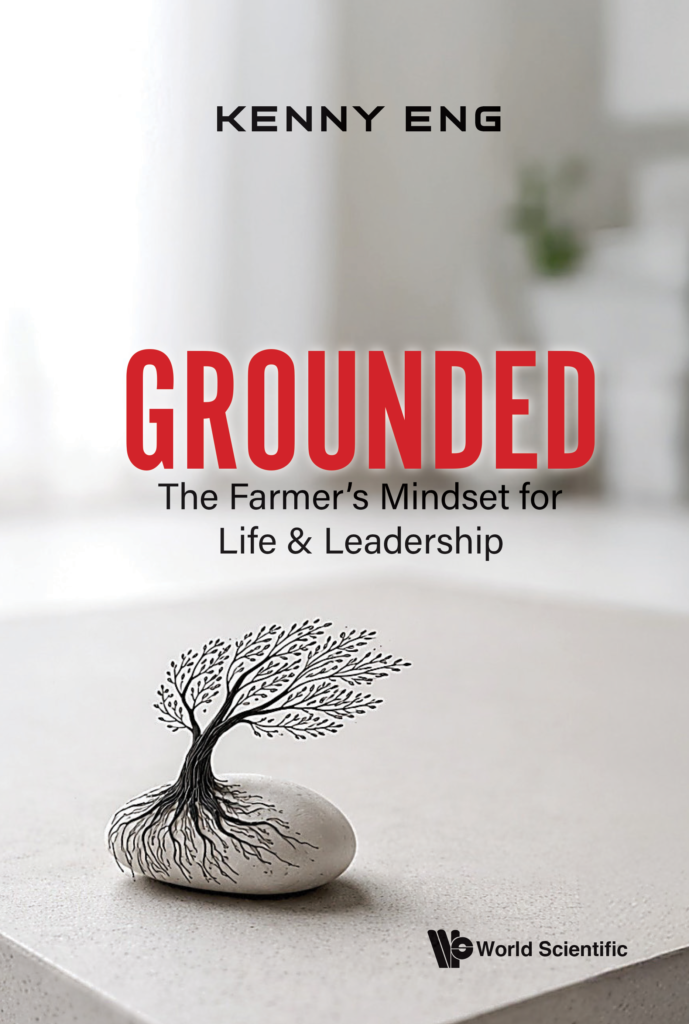
by Kenny Eng
Leadership today often feels like a race — a race to adapt faster, to juggle more, to stay one step ahead of disruption. Every headline brings a new urgency. Every week, another shift demands our attention.
What I’ve learned is this: leadership isn’t about keeping up. It’s about grounding down.
Drawing on four generations in horticulture and decades of work alongside local farmers in Singapore and across the Commonwealth, Grounded offers a different way of seeing — one rooted in purpose, strengthened by resilience, and sustained by collaboration. Through stories from the field and from leaders who chose depth over speed, Kenny Eng shows how the farmer’s mindset can guide us to live and build in ways that endure.
At the heart of the book is the GA Tree Framework — a living model where purpose anchors like roots, resilience bends like a trunk, and collaboration reaches outward like leaves.
If you’re leading through uncertainty and looking for something steadier than speed, this book is an invitation — to slow down, reconnect with what matters, and grow with intention.
Available in: Hardcover, Paperback, eBook
Inside the Book
Leadership isn’t about keeping up—it’s about grounding down. This introduction explores how farming offers the lessons modern leadership needs most: clarity, patience, and the courage to grow with intention rather than speed.
“When the root is deep, there is no reason to fear the wind.”
Part One: The Farmer’s Mindset
Foundations for Growth
Growth doesn’t come from piling on more — it comes from clearing space. Through Yili Farm’s Alan Toh, Don Norman’s call for humanity-centred design, and Steve Jobs’ radical simplification at Apple, this chapter shows why farmers don’t force growth; they remove what’s in the way.
Key lesson: Simplicity is not the opposite of ambition. It’s what gives ambition depth. Without clarity, even the best seeds cannot take root.
Harvest Note: Pull one weed that drains your focus.
Resilience isn’t resistance — it’s renewal. Through Project ComCrop, Tata Group’s response to crisis, and ASICS’ purposeful adaptation across decades, this chapter shows how resilience flows from shared purpose, not individual will.
Key lesson: Purpose acts like a compass when storms gather. It doesn’t give you every answer — but it points you toward your true north.
Harvest Note: Name one principle you will protect, no matter the storm
Farmers don’t predict the weather — they prepare for it. From The Local Farm’s journey with food security to DBS Bank’s transformation and Banyan Tree’s humility in change, this chapter shows how adaptation begins with observation and is sustained by purpose.
Key lesson: Adaptability is not about abandoning your roots. It means deepening them, so you can bend with the wind and still hold firm.
Harvest Note: Notice one shift at the edge of your work and adjust before it becomes a storm.
Part Two: The Grounded Awareness (GA) Tree Framework
A Living Model for GA
What happens below the surface determines what survives above it. A tree can lose branches and still live — but when the roots are weak, even a gentle wind brings the whole structure down. This chapter explores how purpose works the same way: unseen but essential, quiet but powerful.
Key lesson: Purpose is not a mission statement. It answers the deeper question: Why does this matter at all? When storms hit, vision can feel too far away and mission too abstract. Purpose steadies you in the present.
Harvest Note: Write one sentence that answers: Why does my work matter?
The trunk of a tree connects its roots to its leaves. It carries water and nutrients upward, distributes strength outward, and stands firm against the weight of storms. It bends but rarely breaks. This chapter explores how resilient leadership forms the same way — layer by layer, decision by decision.
Key lesson: Resilience is not about never bending. It is about learning how to bend without losing shape. The trunk does not compete with branches and leaves; it supports them.
Harvest Note: Recall a moment when you faced uncertainty. What helped you continue?
Leaves are the visible sign of life on a tree. They stretch outward, reaching for the sun, and transform light into nourishment that sustains the whole. This chapter explores how collaboration — like leaves — is the outward reach that extends impact beyond what we could ever achieve alone.
Key lesson: True collaboration begins not in agreement but in empathy. It’s the willingness to suspend certainty long enough to see the world through another’s eyes.
Harvest Note: Identify one collaboration in your life that no longer serves its purpose — and prune it.
Part Three: Nature as Teacher
From Seed to Renewal
The quality of seeds, and the care taken during germination, often determines the harvest. From a father’s pots of celosia to Singapore’s tree-planting legacy, the Eden Project, and LEGO’s return to its founding idea, this chapter explores why the most important growth is often invisible at first.
Key lesson: Legacy is born in hidden seasons. A teacher may never see the student’s fullest life. A leader may sow values that only bear fruit in the next generation. Keep planting faithfully, even when outcomes are uncertain.
Harvest Note: Start something small today that others can grow tomorrow.
When I first learned about photosynthesis as an eleven-year-old, it seemed almost magical — how plants could turn sunlight, water, and air into nourishment. Years later, I came to understand that trust works in much the same way: invisible yet vital. Through Singapore Airlines, Toyota, and the Kranji farming community, this chapter explores how trust is built not in grand gestures, but in daily, quiet acts.
Key lesson: Trust isn’t built by what you say on stage, but by what people see you do off it. Like photosynthesis, it happens silently — yet its effects are visible in everything that follows.
Harvest Note: Trust, like photosynthesis, is quiet work. Keep showing up in the light you have — daily, faithfully, and with care. Over time, that light becomes life for others.
In nature, nothing really goes to waste. After a harvest, what looks like an ending is often the beginning of renewal. Through TLF’s gelato initiative, Toyota’s recall crisis, and Satya Nadella’s cultural reset at Microsoft, this chapter explores how setbacks — when turned with honesty, reflection, and time — become the richest soil for what comes next.
Key lesson: What looks like failure is often just transformation. Composting doesn’t work if you leave things sitting there. You have to turn it — reflect honestly, mix in some air, give it time. Slowly, it changes.
Harvest Note: The edge is where learning lives. Don’t fear the unfamiliar. Meet it with curiosity, humility, and purpose — and let it grow you. Learn one new thing you were afraid to try previously.
Farmers know that no harvest stands alone. Every season begins with something carried over from the last. Through Elim Chew’s social entrepreneurship, The Wishing Tree installation in Lyon, National Geographic’s cross-disciplinary model, Bosch’s century of trust, and Tata Group’s multigenerational purpose, this chapter explores how leadership — at its fullest — is about what continues to grow after we are gone.
Key lesson: Pollination isn’t about size or fame — it’s about connection. Ideas stagnate when hoarded but flourish when exchanged. What we share keeps the ecosystem alive.
Harvest Note: Pass something on this week — an idea, a habit, or a bit of wisdom — without expecting return. Growth multiplies when it’s shared.
Part Four: Putting It into Practice
From Understanding to Action
Tending Your GA Tree: Know Where You Stand
My father doesn’t guess what his plants need. He checks them. Not constantly, not obsessively — but regularly. You can’t tend what you don’t see clearly. This chapter gives you a simple rhythm for assessing your tree: a weekly root check, a monthly trunk check, and a quarterly leaf check.
Key lesson: Assessment isn’t judgment. Knowing where you stand — honestly — is how tending begins.
Living The Farmer’s Mindset: Sustain What You Have Built
Knowing is not enough. Assessment shows you what needs attention. Daily practice shows you how to sustain it. This chapter brings Simplicity, Resilience, and Adaptability together into one integrated daily rhythm — not three separate tasks, but one way of moving through your work.
Key lesson: Think of the homeowner who tends their plants each morning — pulling a weed, turning a pot, checking the soil. They’re not doing three things. They’re doing one: caring for what they’ve planted. Leadership is the same.
Your First 30 Days: Building The Farmer’s Mindset
You know the three practices. Now it’s time to make them automatic. This chapter guides you week by week through your first 30 days — building the muscle memory so that the morning question, the recovery pause, and the Friday shift notice become as natural as breathing.
Key lesson: A farmer doesn’t abandon the field because of one missed watering. They come back the next morning and tend again. Same with you. The practice is always there, waiting for you to return.
A return to what matters most
Farmers don’t prepare the soil for just one season. They work the land so it can keep giving year after year — even for the generations who will come after. Leadership is no different. The true test is not how much we can achieve quickly, but whether what we grow can last.
Before you close this book, three questions remain:
- Where are your roots planted?
- How strong is your trunk?
- What kind of growth do your leaves nourish?
The answers don’t need to be perfect. But they will guide you — just as the sun guides a farmer tending the field.
You might find this useful if you:
- Feel the pull between moving fast and staying true to what matters
- Are navigating a season of change — in your work, your family, or yourself
- Lead others, or simply want to live with more intention and less noise
- Believe that how we grow matters as much as how fast we grow
- Are building something meant to outlast you — a business, a family, a community
- Value patience and purpose over quick answers
- Are searching for a quieter, more grounded way to see the world
This book might not be for you if:
- You’re looking for a step-by-step formula or ready-made templates
- You want tactics without the stories and seasons behind them
- You’re seeking quick wins over lasting roots
The answers don’t need to be perfect. But they will guide you — just as the sun guides a farmer tending the field.
This is the invitation Grounded offers. Not a race. A return.
New phones available
Get Your Copy
Book Details
Publisher: World Scientific
Format: Hardcover, Paperback, eBook
ISBN 978-981-98-2879-1 (hardcover)
ISBN 978-981-98-2957-6 (paperback)
ISBN 978-981-98-2881-4 (ebook for individuals)
Published: 2026
Language: English
Available At:
To be announced soon.